Rural Education and
Rural Development
A Conversation with Michael Corbett
Abstract: It is impossible to seriously consider the future of rural places without addressing the role of education. Michael Corbett, a leading scholar in the sociology of rural education, has for decades challenged us to see schools both as community assets and as complex institutions that often, paradoxically, facilitate out-migration. His seminal book, Learning to Leave: The Irony of Schooling in a Coastal Community (2007), is essential reading for anyone seeking to understand how educational processes can devalue local knowledge and orient young people from rural areas toward distant, urban futures. Given this volume's goal of challenging the pervasive "urban bias" in development thought, we could think of no better person to help us explore the deep connections between rural education and rural development. In this conversation, which took place over email between March and June 2025, Corbett guides us through the personal and intellectual journeys that shaped his scholarship. Grounding his work in his own family's history of mobility and his early experiences in a rust belt town in Nova Scotia, he explains the core arguments that animated Learning to Leave. Yet the dialogue also moves beyond this classic text, revealing the evolution of his thinking on gender, labor, and the complex ways of defining "rural" itself. Of particular importance is his critique of "place-based education," where he warns that an apolitical focus on "the local" can inadvertently foster the insularity and resentment that fuels right-wing populism. Corbett then shares constructive examples from his early teaching career in a Cree-Métis community, illustrating how a curriculum rooted in local inquiry, oral history, and shared practice can empower students and strengthen communities. The conversation concludes with a hopeful, if cautious, vision for reparative rural futures.
Kerilyn Schewel: I'd love to start by learning more about you and your personal background. Could you share a bit about where you come from? What initially sparked your interest in rural places and, more specifically, in the field of rural education?
Michael Corbett: I grew up in a place that was changing in a way that was not uncommon in North America in the mid-1970s. My mom's people are Acadian, the original French settlers who arrived in what is now Atlantic Canada in the early part of the seventeenth century. Most of this group came from parts of France devastated by the Wars of Religion in the late 1500s, which killed an estimated three million people.1 By the middle of the eighteenth century, they were caught up in the ethnic cleansing known as le Grand Derangement. In my Anglo schooling, this was known as "The Expulsion of the Acadians"—which sounds a bit like getting kicked out of school. The reality is that families were separated and displaced, property was seized by the British colonial authorities and distributed to New England Planters (as the settlers who moved from New England to Nova Scotia following the Acadian deportation were called), and up to half of the settled Acadian population perished in the ethnic cleansing.2 What is important is that my Acadian ancestors returned to what would become Atlantic Canada, or what was, and still is, Mi'kma'ki. As history progressed, the family, which was monolingual Francophone, moved to an English community for employment at the beginning of the Second World War. By the 1960s, when I was a child, only one among my generation of twenty-three first cousins on that side still spoke French.3
My last name, which is Irish, comes from my father's ancestors, who emigrated from southern Ireland around 1820. Again, it was religious conflict that motivated the migration—but this time, they were escaping the turmoil and colonial/sectarian violence that followed the Napoleonic Wars. Within a couple of generations, they became merchants and regularly moved back and forth between Nova Scotia and New England. When the business collapsed around the time of the First World War, my grandfather and father became railway workers, and it was railway work that brought my father into my mother's community, where they met.
I think growing up around those enormous trains—and the incessant movement of people through the railway station where I hung around collecting pop bottles and selling newspapers—gave me an embodied sense of mobility as a normal feature of life. And the giant North American railroad map on the wall in my father's office fascinated me. I spent hours looking at that complex web of rail lines and dots that represented places that sparked my own mobile imagination. My family is not one of those multigenerational settler families that claims any sort of natural ownership or affiliation with any particular geography. If I have a family tradition around place and space, it is more one of mobility and the opportunities that reterritorialization provides.
I grew up in a small mill town that prospered during the two world wars and which continued to survive afterward by supplying American military machinery during the Vietnam War. It was also a transportation and communications hub and my father's 1960s and early '70s small-town train station was a lot like a contemporary airport. However, as the Vietnam War wound down, employment in the steel mills dwindled and Amherst, Nova Scotia, became a rust belt place in which the implicit and explicit educational messaging was that young people had to get out of town to have a future. I did just that.
Fast-forward past university and teacher education: I found myself teaching in an Indigenous community in northern Manitoba for four years. I think the educational mobility message I received in my own youth framed how I initially saw my role as a teacher in a nonmetropolitan "left-behind" community. But those four years completely overturned what I thought I was doing as a teacher and my understanding of place, space, and culture. In particular, I started to wonder about the effectiveness of a system that seemed to have so little connection to the community it operated in and on.
It started to appear to me that schooling was playing a highly ambivalent if not assimilatory role in the community. I think this sense of disconnection between schooling and life in the community is what motivated my academic research. I worked for nearly twenty years as a public school teacher in an Indigenous, rural northern Manitoba community and in several rural schools in Nova Scotia. My interest in mobility comes from trying to understand people who were rooted and less interested in jumping on the education train that was headed out of town.4
Kerilyn: I first came across your work when a friend recommended your book, Learning to Leave: The Irony of Schooling in a Coastal Community. Could you paint a picture of Digby Neck in Nova Scotia for us? What did you mean by the "irony of schooling" in that context and can you explain more about its connections to out-migration?
Michael: The central argument of the book is that rural schools ironically tend to erode the human resource base of their communities by implicitly and sometimes explicitly promoting out-migration. The tension between forms of education that support rural community development, on the one hand, and the promotion of mobile, liberal individualism through credentialled educational achievement, on the other, generates a core ambivalence about the ultimate outcomes and value of education.
Digby Neck is a long, thin peninsula that juts out into the Bay of Fundy, which is one of the richest marine ecosystems in the world. The Neck, as it is called, contains a set of twelve small villages. A single road joins these villages to the larger Nova Scotian peninsula. These villages are intimately connected to the fishery for obvious reasons. From 1989 into the early years of the 2000s, I worked in the area's elementary school, built in 1957 to consolidate several small village one- or two-room schoolhouses. Highway 217 was paved in the mid-1950s and a regional high school was constructed in the town of Digby, also in 1957.
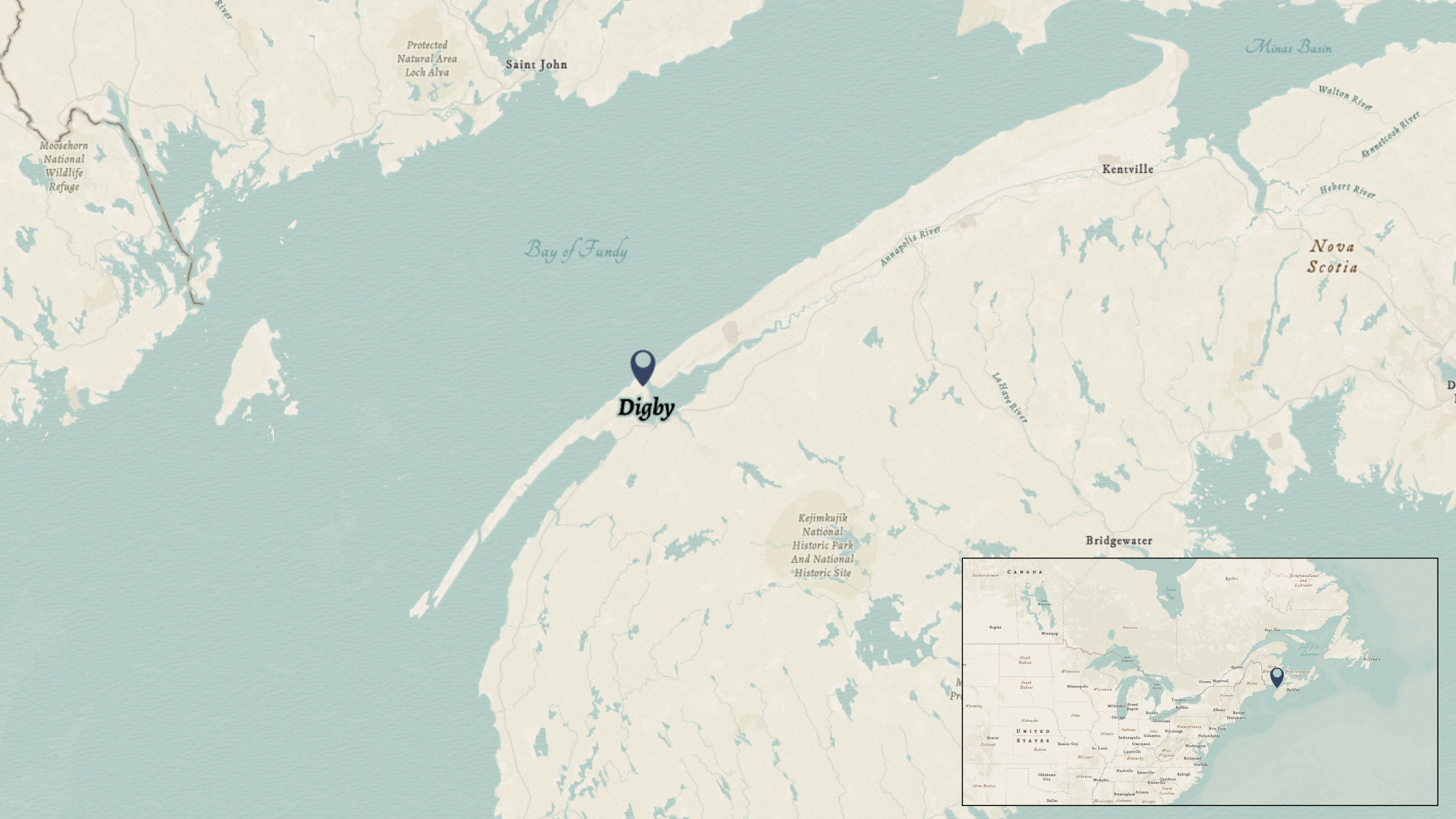
Figure 1: Digby Neck, Nova Scotia. Map created by Pivot Press using ArcGIS Online, 2025.
The pavement changed the educational geography and mobilities in the area. Most of my colleagues at the school were fishermen's wives late in their teaching careers. I learned about the history of schooling in the villages by listening to their stories about people and place, and there was always a subtle theme of how some former students had "done well" and "gone far" with their education and with their lives. Others had "just stayed around," and had not finished their schooling but instead, "went to work." There were no value judgments in the way those teachers spoke; it seemed more a question of who took advantage of which opportunities or who was or was not academically inclined. I learned later that older generations of village teachers explicitly demeaned a life in the fishery.
Around the time I took that job on Digby Neck, I finished a master's thesis in sociology, and I suppose I was thinking structurally about the work I did as a teacher in Manitoba and in rural Nova Scotia. I wondered specifically if there were any patterns in the way that different individuals made their educational and life choices. Indeed, is choice even an appropriate way to frame the way that different life courses developed? And, even more fundamentally, would it be possible to map and analyze the educational, mobility, and occupational trajectories of the people who had gone to this little elementary school?
Thus, I came up with a straightforward set of fundamental research questions: Who stays? Who leaves? Why? And what role did formal education play in relation to mobility trajectories? What I found was not surprising. The further away people moved, the more likely they were to have completed high school and moved on to higher education of some form. Yet about two-thirds of the people in the sample had remained within fifty kilometers (thirty miles) of where they grew up and this group was much less likely to have completed high school or pursued post-secondary programs. The education-mobility connection was even more pronounced for men than for women. There are, of course, other details in the mix of this analysis, but the irony I hypothesized was that success in school was associated with leaving the community. My data confirmed this relationship in a way that left little room for doubt.
This hypothesis has often been conflated with the classic "brain drain" notion that formal education "creams" off the best and the brightest, leaving the rural community with its least able young people. I think this is a misreading of what I concluded in Learning to Leave. To understand why this is not the classic brain drain story, you need to understand a related irony here, which is that there were significant opportunities available to young people in the industrializing fishery of the 1960s, '70s, and '80s that provided good options to a considerable proportion of the male population that did not require formal education.
In fact, in order to prosper in the fishery of that time, schooling might actually be an impediment and a "waste of time" that would detract from the practical apprenticeship required to work there. There were skills, sensibilities, and, indeed, a physical and mental hardening that was best learned young. Many men spoke about the importance of this informal educational system that operated entirely apart from formal education. You couldn't really do both.
Indeed, there was something of an inversion of the brain drain hypothesis because it was actually those who lacked the native, embodied intelligence to just "know what to do" on a fishing boat or how to deal with the complexities of managing a fishing family, who had to rely on the relatively easy, less lucrative, safe path laid out by formal education.
Kerilyn: How has your thinking evolved since Learning to Leave was published? Is there anything about the arguments you made then that you would revise or present in a more nuanced way today?
Michael: I wish now that I had paid more attention to the emerging literature on masculinities and gender in education. My data showed that women achieved more schooling than men and were more likely to leave the local area, but my analysis of how that worked was not as nuanced and deep as it could have been.
I also paid little attention to cultural features of life in the community and how subjectivities were formed through, and in reaction to, religion, local organizations, media and emerging communication technologies, and back-and-forth migration to other parts of Canada and the world. I did see these things on the horizon, but I think the stayer-leaver binary I found and focused on prevented me from noticing and analyzing how more flexible identities and different forms of mobility were shaping subjectivities.
Another blind spot is that, while I did have some sensitivity to the local culture, I largely missed how my interview data contained a great deal of information that I think could be interpreted using new materialist theoretical tools to tell a very interesting story about the entanglements of the human and more-than-human world.
I realize now that most of the people I spoke with saw themselves enmeshed in time and space and showed a deep emotional bond with land, sea, animals, and people. Rather than the largely Marxist analysis I developed, these intra-relationships to which the feminist new materialists sensitize us might better explain how schooling and life in the community contained the core ambivalence I found.5
For instance, in my research this entanglement has been framed with both pride and shame for some fishing families about how they did, or did not, participate in the destructive industrial fishery of the 1970s and '80s. But these reflections were always mixed in with strategizing about the future and thinking in open-ended ways about how things came to be what they are, as well as what to do moving forward. I think my analysis was too cut-and-dry—which I think is a chronic feature of a lot of social science of that time, relying as it did on relatively neat explanatory theory and with its drive for authoritative explanation.
Kerilyn: I would love to get your thoughts on some of the themes we are tackling in this volume on rural futures, starting with the most fundamental: what does "rural" mean?
Michael: There has been a lot of ink shed about how to define "rural." Some argue that it isn't worth thinking about very much because "rural" is a bit like the old saw about pornography—"I don't know how to define it, but I know it when I see it." But that is a bit of a cop-out, I think.
First of all, while there is no agreed-upon definition of what counts as rural in demographic terms, virtually every country in the world, and most of the global bodies that create multi- and transnational policy and analysis, have one or more ways to separate out rural spaces, either in binary fashion or in terms of some kind of continuum. These top-down definitions have consequences.
I could also ask somebody I encounter whether or not they think their small town is rural. This way of approaching the problem is to relate the definition to the way that people make meaning for themselves and for where they find themselves. There is a long tradition of qualitative work in my field of rural education that focuses on this and tries to make sense of how rural identity, for instance, might relate to schooling, pedagogy, and curriculum. These approaches nearly always include a material dimension and a visual imaginary regarding the way rural is considered in vernacular discourse, and to some extent, in academic work.
Definitions are never innocent. Because the fields of rural studies, rural sociology, and rural education were historically tied up to such a degree in binary definitions of urban and rural, scholars of these disciplines (particularly in rural education I have argued) have been slow to think relationally about what constitutes rurality. This, I think, has been a component of a movement I count myself a part of that promotes more robust theoretical work in the field. Rather than ignore the definitional problem, simply accept only a "40,000-foot" statistical demographic definition, or leave it to the subjective judgment of individuals, contemporary thinkers have productively used the work of critical geographers like Doreen Massey, Edward Soja, Paul Cloke, or Keith Halfacree, all of whom draw on the foundational analysis of the production of space by Henri Lefebvre.6 In this tradition, following Lefebvre, rural is considered as both a real and imagined space that is perceived (what is seen, heard, felt, etc.), conceived (how space is represented symbolically), and lived (the subjective embodied experience of/in place and space).
More recently, spatial analysis in rural education research has been pioneered by Bill Green and colleagues in Australia and this work has considerably advanced the field.7 As Green puts it, we need more complex spatial understandings that force us out of the simplistic either-or conceptions of space to do the hard work of thinking in multiple dimensions at the same time.
At one level, rural is the physical space represented by the picture I see out my window as I write this at my desk in a coastal village in Nova Scotia or by the farms that I drive by on my way to "town" for groceries. It is also the Canadian government creating a map that shows which areas of the nation are rural (always partially and problematically), one of the hundreds of sea- or farmscapes in the local gallery (equally partial and static), the folk songs I sing, or when I read a novel like Barbara Kingsolver's Demon Copperhead.8 And, finally, it is also the experience of living in my village.
Thinking all of this together and inflecting it with even more complex structural and systemic questions of history, change, population formation, and power make the business of thinking about "rural" a complex theoretical project. When we theorize at this level, the simplified comfort of the rural-urban binary falls apart, which obviously complicates the definition.
Why does this matter? Well, I think if we ignore relationality and nuance, we open the door to the dangerously corrosive politics of "us and them" that animates too much of our current discourse. As I write, we are immersed in a natural experiment that amounts to learning the material and emotional consequences of this antagonistic polarized view when it achieves hegemony.
Kerilyn: It is my impression that the field of "rural development" appears to have faded in recent decades, particularly after the 1990s with the acceleration of neoliberal globalization, the rise of global cities, and an urbanization of the social imaginary. It seems that people have given up on the idea of advancing a parallel or distinct process of rural development separate from "national" or "global" development. Do you agree? How have you seen conversations about "the rural question" change over the course of your career? In what ways are we limited by seeing the rural as distinct from the urban—and, conversely, why is it important to do so?
Michael: The urbanization of the social imaginary, as you put it, drawing on Charles Taylor, is indeed something that intrigues and troubles me.9 The conflation of urbanization and development is shared by left and right. Marx's notion of rural idiocy and Adam Smith's idea that people are naturally drawn to the lucre and lure of the city share a common urban teleology. It is simply assumed that the emptying out of the countryside is a natural side effect of industrialization, development, and progress. This is a very old idea that I wanted to challenge in Learning to Leave. It is also an idea, and indeed a geopolitical orthodoxy that I have long thought is both dismissive of rural people and communities and ultimately corrosive to democracy as we are learning at our peril.10
The logic of this general framework of progress and development intersects with the related logics of colonialism, as the Dependency Theory tradition has long pointed out. Here, the "northern" urban metropolis exploits the "southern" rural periphery in a way that actually defines development in terms of the eugenic and racialized rationalization of this uneven relationship.11
The drift toward erasure of distinctly rural educational issues that you allude to has also long operated in different national education systems. For example, I have done some work in China recently where the rural population is still around forty percent of the national population, while the overarching Chinese labor force strategy is to increase the urban population to eighty percent, which is the situation in the most "advanced" capitalist societies. Rural labor has long been critical to urban development and the learning-to-leave phenomenon I have written about resonates with Chinese rural education scholars. Most young people there want out of the countryside, and education is a key mechanism for making the transition to urban opportunity, so there is considerable pressure on rural youth to perform in school and move to urban areas. But there is an increasing recognition that this urbanization policy is problematic, and, in recent years, a robust and distinctly pro-rural education scholarship has emerged in China.
Rural education researchers in the Anglosphere have spent at least the last-half century working to keep "rural" on the policy agenda. In rural education scholarship in the UK, Australia, Canada, New Zealand, many parts of Europe, and the US, our focus has been on how rural peripheries are systematically disadvantaged by economic and social policy that is pretty much exclusively focused on the urban. In this sense, we argue that the rural is considered vestigial and that, if there is anything resembling rural education policy, it amounts to closing things down and moving people out. So a lot of rural education scholarship amounts to activist attempts to resist the policy vacuum and the drift toward placeless standardization, marginalization and erasure. These efforts have been sometimes met with some measure of success, particularly in decentralized systems of governance like the US and Canada where rural voters have considerable power.
As a result, the rural has never been entirely off the education policy agenda, particularly in the US, where many people staunchly defend states' rights and local governance. But this creates another sort of problem in my view. Throughout my career, I have noted a disinclination in North American rural education scholarship to develop a cosmopolitan and relational focus and to embrace new theory. For example, there is a tendency in rural education research in the US to focus almost exclusively within the country and, indeed, on "place-based" micro-situations in specific regional geographies and places.12 This is in part why I have been critical of the place-based education movement in rural education and feel that it points the lens inward toward the autonomous spatial imaginaries of rural settler "communities" threatened by outside interests.13 I think this is really quite dangerous because it creates resentment, racism, and a sense of insularity that has been very easy for right-wing populist political actors to exploit.
Kerilyn: Could you share a bit more about that critique of place-based education? Why is it misguided or even dangerous to see rural places as autonomous communities threatened by outside interests? And do you think we need to make a distinction between Indigenous communities, like the one in which you worked in northern Manitoba, and other rural communities—like, say, Digby Neck—in that regard?
Michael: I do think we need to make a distinction between Indigenous and non-Indigenous settler communities. The land-based education movement is quite distinct from the place-based education movement largely because the former has been developed by Indigenous scholars and activists working to revive languages, cultures, and economies that have been distorted by colonial capitalism.14
The point, as I understand it, is to support both the production and dissemination of Indigenous ways of understanding and caring for the land through a relational ontology that respects and honors the entanglement of the human and the more-than-human. Land is not a commodity in this framing. Rather, land, language, deep history, spirituality, and culture are inextricably intertwined.15 But land-based education is also situated in a political project to problematize the whole idea of land ownership, property, and sovereignty that have been distorted by the ubiquitous and thoroughgoing commodification that has dispossessed the original inhabitants of Turtle Island/North America.
Place-based education, on the other hand, tends to be a soft-liberal pedagogy which is largely bereft of politics, although there are exceptions such as David Greenwood, who takes colonial history and geography very seriously. The basic idea is to use the natural affordances of place to help young people get more in touch with ecology and their physical environments. The term "environment" is critical here because it assumes, I think, a core humanist problematic that juxtaposes people and environment as though they are separate entities (see note 5 above). Place-based education can very easily instantiate and either implicitly or explicitly support binary conceptions of here and there, local and global, insiders (us) and outsiders (them). So, this is one problem.
The absence of a political foundation for much of this pedagogy can also foster the idea that the place I find myself in is somehow rightfully my place. I have seen this kind of sensibility operating in the rural communities I've worked and lived in, where people can be quick to defend what they see as their rights of ownership. This sometimes takes the form of Indigenous-settler conflict such as disputes about the Indigenous fisheries in Atlantic Canada, in which "licensed" settler fishers claim that their livelihoods are jeopardized by what are ironically described as Indigenous "outsiders" or "newcomers" to the industry. The argument here includes ideas like industry, licensing, rights, heritage, and even ecological protection, all of which are critical rhetorical devices used to establish place-based forms of settler ownership. Indeed, as Darryl Leroux has demonstrated, in eastern Canada, there are numerous settler groups that actually claim indigeneity and press for additional harvesting privileges based on these unfounded claims.16
Of course, most place-based educators just want to get kids outside. In rural contexts, this is a common-sense approach. The rural school grounds are an obvious natural science laboratory. The movement, for the most part, would probably claim political neutrality or a kind of pragmatic local and/or environmentally conscious innocence. But the nascent or latent alignment of people and place can easily feed into reactionary politics and turn the curriculum away from understanding the linkages between places in an increasingly globalized world.
Indeed, it is precisely the severing of these linkages that new forms of populism promote, which is why place-based anything is inevitably political—and, I think, potentially dangerous. I have suggested the rather clunky term "place-relational" to illustrate the importance and value of recognizing and examining inevitable complex linkages in education.17 As the land-based education movement, critical race theory, and critical pedagogies demonstrate, these linkages are never innocent nor unproblematic. Any colonized place is a contested political and economic construction built on a history of violence and displacement, which, it seems to me, calls for a focus on difficult dialogue, reparation, and justice.
Much of what I just described has been sidelined and indeed plastered over with place-based, nativist discussions of who belongs where that creates a political landscape of insiders and outsiders rather than a trans-local citizenry. As much as it is the material locus of social life, place is always a problematic, multiscalar, and elastic idea. Any imaginable place contains infinite other places. At the same time every place is part of an equally infinite number of larger imaginable places.18 And, of course, there are virtual places and spaces today which ironically seem to be morphing and even compressing space, driving dangerous and divisive place-based politics. The fundamental data that runs the large language models we call AI is a mechanism through which the ever-increasingly granular place-based information gathered and analyzed by ever-increasingly powerful computing machines.
I think what we are living through at the moment is a new phase of capitalist development that includes the incursion of new digital technologies (most notably AI), a sociopolitical shift toward insularity, regionalism and nationalism, and a return to more authoritarian forms of place-based politics and religion (often conjoined). What I see in all of this is a retreat from a more expansive and hospitable vision of sociality into defensive and frightened fortress mentalities. A fortress is a place with walls around it after all. The spread of digital technologies that allow me to sit in my rural home and visit libraries and art galleries all over the world and communicate with just about anyone has also ironically enhanced the manipulative power of those with resources to regulate my digital experience and narrowcast content that aligns with my prejudices. So, despite the notional scope of my access to ideas and information, my world is effectively compressed by the algorithms that curate the content I receive, keeping me in the comfort of my digital village.
Place is complicated, and local relevance in curriculum matters a great deal. But place is also ideologically constructed and never a naturally occurring spatial container. Place is commodified and contested, and I think we need a more cosmopolitan, critical education that helps us see outside the places we find ourselves in (including virtual locations) rather than one that promotes digging deeper into the narrow and known world into which we are thrown.
Kerilyn: Critiques of formal education and its role in "disembedding" people from place, tradition, and local knowledge aren't new, as we both well know. Sometimes it feels to me that we keep rehashing arguments developed decades ago, just in new contexts or ever-more-sophisticated ways. My work on formal schooling in rural Ethiopia uncovers challenges similar to the ones you found in coastal Canada—its irrelevance to local livelihoods, the way it fosters deskilling and unattainable urban aspirations, and how it deepens rural discontent. While cross-context comparison is valuable, sometimes I feel like, when it comes to the "rural question," we aren't making much progress. If anything, we're losing ground. Perhaps part of the problem is that, as academics, we often excel at critique more than construction.
So, let's push beyond critique for a moment—what are some of the most promising or innovative approaches to rural education you've encountered? Could you walk us through some real-world examples, perhaps from your own experience, of a curriculum that doesn't aim to help students "learn to leave" but instead equips them to thrive and contribute right where they are?
Michael: If you start from the assumption that teachers should be learners first of all—and even anthropologists, as I argued (drawing on the literacy theorist Frank Smith) some years ago in an article in Teaching and Teacher Education—then the focus of the work of teaching shifts.19 Pedagogy becomes a form of teacher inquiry, and curriculum becomes an invitation to engage local knowledge and bring it into conversation with the kinds of disciplinary knowledge that frames school curriculum.
So, what might an education that doesn't focus on moving people out of rural communities look like? When I arrived in a Cree-Métis community in northern Manitoba in 1983 as a very young high school teacher, I came with my emancipatory critical pedagogy and a pretty conservative teacher education focused on lecturing, Socratic questioning technique, and written test-driven assessment.
The teaching techniques in which I was trained failed badly. After getting over the shock (well I'm not sure I have ever recovered entirely), I decided to employ the skills I had, which were how to do social science research, how to write and play songs on the guitar, and how to repair and build things (a legacy of my working-class background).
Thus, I began an inquiry into why my curriculum was failing. I was living with a young man who was a biology major hired as a science teacher. His inquiry into failure seemed to ask the questions: what is wrong with me as a teacher, and what is wrong with these kids? I must admit that I had those questions too, but I also had enough sociology to understand that nothing ever boils down to individual psychology.
Because I play music and sing, I had easy and immediate access to the homes of local people. On my first night in the area, I was invited to play at a community event. These invitations were constant throughout my four years there. I was invited to go fishing on Lake Winnipeg and to learn about the inland commercial fishery, the provincial marketing board, and the quirky mechanics of those Bombardier ice tractors that the fishers used. When the ice melted in late May or early June, the families in the community still went to fishing camps on the lake. I remember fishing in frozen lake water right up against a retreating, two-meter deep ice sheet that was a shimmering chandelier of icicles melting in the sun.
All of these experiences were data that I used to make sense of why my standard government curriculum was such a total failure. Talking to people in their homes, in the bush cutting firewood for elders, moose hunting, or out on the lake ice fishing, I also learned that, up until a few short years before I arrived, children were still beaten for speaking Cree on the school playground. I learned about the residential schools and the abuse that the elders experienced there. I was told stories about the construction of the hydro dam in the community in the early 1960s and about how the almost instantaneous appearance of 1,500 construction workers in the community wreaked havoc on people's way of life in horrific ways. I could see that the community was still recovering from these shocks.
And so, what should curriculum look like in this community? Pat Thomson writes about "thisness" based on her research in an Australian rust belt community.20 Rather than speaking about communities in general, as standard curriculum and pedagogic practices typically do, it is her argument that the particularity of locales should be integral to how schooling is imagined. The school authority I worked for in the early '80s was just beginning to understand that curriculum and Indigenous culture can and should be brought together. Finally, after generations of top-down administration, there was some limited support for bringing elders into the schools to teach and to allow teachers to engage the community in a locally-focused curriculum.
I will give a couple of examples of what this looked like. The first one was very simple and amounted to an oral history project and what we would call "photo-voice" today. I noticed in our social studies curriculum materials that we had very little Indigenous content. Nor was there any reflection of the community itself in these materials, other than a bit of Manitoba Hydro propaganda lauding the technological wonder of the local hydro dam. The book room of the school was full of generic textbooks, some of which were actually quite racist in the way they depicted Indigenous people.
Talking with Indigenous friends in the community, I was told that all they learned about themselves in school was that they were losers who essentially disappeared from the historical and geographic narratives after the Europeans arrived. This seemed to be recapitulated in the construction of the hydro dam within living memory of my friends who could remember the day the bulldozers came through the trees opening up the construction road to Winnipeg.
I decided that, if curriculum materials were inadequate, my students might create them. The project had two parts. First, we came up with an elders' questionnaire to investigate the history of the community. Each student was required to do at least one interview, recorded on cassette tape. Some did several. We invited some of these elders into the classroom to talk about local history. And, for the first time, we sat in a circle and smudged with the smoke of sweetgrass. It felt like the beginning of something.
We also got a small grant for a second part of the project, which was to purchase still cameras with which the students could photograph their favorite outdoor and indoor places around the community, learn about and reflect on these places, and create captions for the photos. Each of these projects brought the community into the curriculum.
Because English was still more or less a second language in the community, this work fit with the language experience and whole language literacy learning model. In this framework, the living language of learners—rather than sets of abstract skills to be mastered—is the foundation for literacy. I wasn't just learning about the community, I was learning how to be a responsive language teacher rather than just a social studies specialist.
The second project was similar yet different. One evening, chatting with a group of Indigenous, non-teacher friends in the community, the discussion turned to trapping. There were still a number of elders who ran trap lines into the bush north of the community. These people were getting quite old, and we decided that it would be a good thing to build a cabin or two for some of them. By that time, I was thinking about how to turn ideas like this into curriculum. So, I took our conversation into one of my classes and asked students to design a cabin.
After this design exercise, I was approached by a young man who rarely spoke and whose attendance in school was very spotty. He was always on the edge of failing or dropping out. He said that he would like to help build that cabin. I asked him if he knew of anyone else who would like to participate and he named another half-dozen young men, all of whom were equally school-challenged.
Over two weeks, we built a very substantial twelve-by-sixteen-foot trappers' cabin that is still standing today, nearly forty years later. Throughout the time we spent in the bush, those boys and the men formed a bond that allowed for the sharing of local knowledge not only relating to the construction of the cabin, but also in terms of animal and plant identification as well as stories relating to traditional hunting practices and the importance of honoring the spirit of the animals and the forest. We cooked, laughed, told stories, played cards, played music, and sang. I expect it was the most impactful educational experience those school-averse boys encountered in their short academic careers.
The final project returns to my musical reputation in the community. Some students approached me and asked if they could have a course in music and drama. The school division superintendent agreed and gave us a budget of $1,000 to get it started.
In those days, this bought us twenty basic guitars. We also used the school's two unwieldy VHS video cameras to create short films. The course ran for two years, and we worked up a guitar orchestra and choir that toured a few schools in northern Manitoba. It was not a polished unit, but this ensemble was enthusiastic, and I think it fit well with the Cree-Métis sense of communal engagement. One of the songs we sang in Cree was entitled "Mamawitan," which in the language means "all together." The verses of the song spoke to the different things that a Cree community does together, such as eat, sing, play, hunt, etc.
The work I describe here is in no way unique; the field of rural education and its key journals and publications are filled with this kind of pedagogy. My point is that, in order for a teacher to develop locally sensitive curriculum, that shift from "dispenser of knowledge" to "researcher" or "anthropologist" trying to figure out where they are and how the locale and its culture can be a source of ideas for curriculum. This means approaching curriculum documents as a set of invitations to improvise rather than as a set of sacred texts meant to be read literally.21
Kerilyn: Let's close by returning to the theme of rural futures. Looking at the current historical moment—with its unique pressures and possibilities—what trends or developments bring you hope?
Michael: The term rural futures is intriguing, if only because so often "rural" is associated with the past. But as I argued more than twenty years ago, the ghost of rurality haunts modernity. There is perhaps no better example than the election of Donald Trump, whose 2016 victory was effectively blamed on rural ignorance. Kat Biddle and Daniella Hall made the point that the election of Trump was indeed a matter of ignorance, but not rural ignorance.22 Rather, they argued that the urban-centric Democratic Party failed to respond to the kind of deep rural angst and sense of abandonment I describe above. The notion that rural people vote against their own interests has become a staple of condescending liberal analysis for decades now, and it is wrong and counterproductive.
I have argued that rural schools may be North America's last bastions of truly inclusive K-12 education in those small communities where the rich and the poor; the Black, the Brown, and the White; and people of different religious faiths and atheists; etc., all attend the same school together. Many rural communities, in my experience, defend their public schools in ways that I have not seen in metropolitan or even large town environments.
I refuse to believe that the American nation-state will devolve into a permanent condition of authoritarian insularity. It may be naïve, but I think it may be those long-vilified rural North Americans who teach the sustainability of the material foundation of the land, water, animals, and plants that require care and attention if we are to survive and flourish as a species. This is the perspective of established American rural eco-thinkers and critical rural educators all over the world.
Emerging Indigenous voices are attending to rurality in ways that are quite different. For instance, Kelsey John and Derek Ford as well as Alex Red Corn and colleagues critique the very idea of rurality as a colonial distortion that justifies intergenerational dispossession of Indigenous people and effectively erases them from the landscape of rural education research.23 Angelina Castagno and colleagues challenge rural educators to support Indigenous students in their community struggles for sovereignty, while David Scott and Dustin Louie analyze Indigenous-settler relations in connection with rural education.24
This work, which is highly critical of rural education as a field, can be read as an invitation and a call for solidarity between Indigenous and rural settler peoples that, it seems to me, reflects things I have heard over the years in rural communities as part of "back-channel" conversations that focus on commonalities rather than on differences and grievances. This is the argument that rural settlers have been pushed aside by the march of capital just as have their Indigenous neighbors.25 Each of these communities, separated by histories of struggle, discrimination, violence, and mistrust have shared similar fates in the sense that many of their members have been marginalized and damaged in the metrocentric meatgrinder, ignored and abandoned by both capital and the state.
In a lovely chapter, Roger Epp shares stories of a number of instances in which rural settler communities in highly conservative western Canada have done the work of reconciliation and reparation of damaged relations in concrete ways.26 These are stories of sharing, caring, and solidarity. They are also stories of what we might call sustainable and historically reparative rural futures, and I think this is where we need to go in the field of rural education as we unlearn those colonial imaginaries that have created the distorted and violent narratives too many of us cling to. We can unlearn what our rural educations have taught us.
I will close with something I've read recently from Indigenous scholar Robin Wall Kimmerer, whom I think everyone working in rural education (well, just everyone actually) should read very carefully. Her books are a wonderful integration of academic botany, zoology, and Indigenous spiritual-material practices.27 And she is a brilliant and accessible writer. Quoting an elder in her book Braiding Sweetgrass, Kimmerer writes that "the problem with these new (settler) people is that they don't have both feet on the shore. One is still on the boat. They don't seem to know whether they're staying or not."28
The question of futures is one that relates to whether or not we are staying. We now inhabit a thoroughly bizarre timespace dominated by Donald Trump's authoritarian ravings and Elon Musk's interplanetary dreams. In one of his last books, which I would also recommend, Bruno Latour describes the current moment as "out of this world" and, like Kimmerer, argues for a way of thinking that gets beyond the antagonistic "attractors" of the global and the local.29 I like to think that the "out of this world" attractors which seem hegemonic at the present moment will be replaced in time by Latour's call for attention to the terrestrial. In such a vision, the focus is not exclusively on the global, or the local, or on fanciful flights to Mars and atavistic and exclusive settler imaginaries. Rather, it is one which attends to the complexity and vulnerability obvious to anyone with both feet on the shore.